


Glaucoma Diagnosis & Treatment in NYC
Glaucoma damages the optic nerve, the nerve carrying what you see from your eye to your brain, usually because pressure inside the eye exceeds what that nerve can tolerate. It rarely announces itself early, so most people learn they have it during an eye exam rather than because something felt wrong. Lowering eye pressure with drops, laser, or surgery can slow or halt the damage, though it cannot restore sight already lost. That is what makes early detection, and an accurate baseline record of your eye pressure and corneal thickness, so valuable.
Glaucoma is a group of eye diseases that damage the optic nerve, most often when fluid inside the eye does not drain properly and pressure builds. Because the earliest losses occur at the outer edges of side vision, many NYC, Manhattan, and Brooklyn patients are frequently surprised to hear the word at an appointment booked for something else, a new glasses prescription or a laser vision correction consultation. At I Love LASIK and Lens, Dr. Samer Khosrof examines the optic nerve and measures eye pressure himself for every patient. He will not proceed with an elective procedure unless the eye in front of him is truly a good candidate.
- What Is Glaucoma?
- Why Does Glaucoma Go Unnoticed for So Long?
- Am I at Higher Risk for Glaucoma?
- How Is Glaucoma Diagnosed?
- How Is Glaucoma Treated?
- Can I Have LASIK or EVO ICL if I Have Glaucoma?
- Does Cataract Surgery Lower Eye Pressure?
- Why Choose Dr. Samer Khosrof for Your Eye Care?
- What Do Patients Say About Their Care?
- FAQs About Glaucoma

What Is Glaucoma?
Your eye constantly produces a clear fluid that circulates through its front chamber and drains through a fine mesh of tissue near the base of the iris. When that drainage slows, fluid backs up and internal pressure climbs. Over months and years, that pressure wears down the optic nerve fibers carrying signals to the brain, and those fibers do not grow back.
Not every case follows one pattern. Open-angle glaucoma, where the drainage channel looks open but works inefficiently, is the most common form in the United States according to the National Eye Institute, and it advances gradually. Angle-closure glaucoma occurs when the drainage angle becomes physically blocked, and a sudden attack bringing severe eye pain, nausea, redness, and blurred vision is a medical emergency. A third form thins the optic nerve while pressure readings stay normal, which is one reason a single pressure number never tells the whole story. Globally the burden is climbing, with 111.8 million people projected to be affected by 2040.
Why Does Glaucoma Go Unnoticed for So Long?
Glaucoma takes peripheral vision first, and your brain is remarkably good at filling in the gaps. The stronger eye compensates for the weaker one, your visual system smooths over missing patches, and nothing hurts. By the time someone notices that objects off to the side have disappeared, meaningful nerve tissue is usually already gone. Roughly half of those with glaucoma are undiagnosed, which is why a dilated exam belongs on your calendar even when your vision feels perfectly fine.

Am I at Higher Risk for Glaucoma?
Anyone can develop glaucoma, but the odds are not evenly distributed. Risk rises with age and is higher for people over 60, particularly those who are Hispanic or Latino, and for Black patients over 40. A family history carries roughly two and a half times the risk compared with having none.
Nearsightedness deserves separate mention, because it is common among patients who come for vision correction. A meta-analysis of thirteen studies found that myopia is associated with roughly double the odds of open-angle glaucoma, with a stronger association in higher prescriptions and roughly two and a half times the odds at negative three diopters or beyond. If you have spent your life in thick lenses, glaucoma screening is not an optional extra.
How Is Glaucoma Diagnosed?
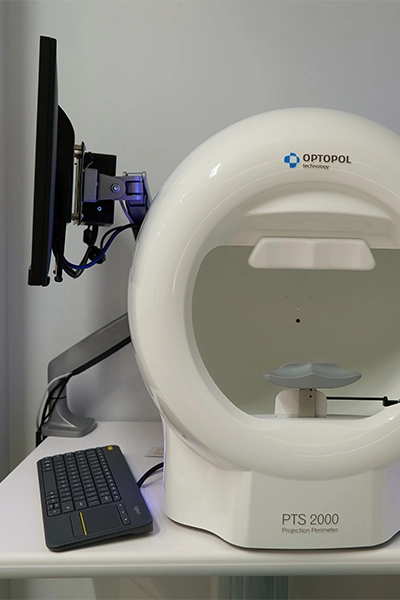
Diagnosis is a pattern read across several measurements, not a single result. Eye pressure is measured with tonometry, and the drainage angle is inspected with a mirrored lens to separate open-angle from narrow-angle anatomy. The optic nerve is examined directly and photographed, and optical coherence tomography maps nerve fiber layer thickness so thinning can be tracked. Visual field testing charts side vision point by point and exposes losses you cannot perceive yourself.
Corneal thickness is easy to skip and important not to. Analysis of corneal thickness data from the Ocular Hypertension Treatment Study identified a thinner central cornea as one of the strongest predictors of who would develop open-angle glaucoma, alongside older age, higher pressure, and a larger cup-to-disc ratio. A thin cornea also makes standard tonometry read low, which can mask a problem. Since glaucoma is judged by change over time, your first visit sets the baseline and later visits give that baseline meaning.
How Is Glaucoma Treated?
Every proven treatment works by lowering eye pressure. Among people with elevated pressure and no nerve damage yet, pressure-lowering drops cut risk by half over five years, from 9.5 percent developing glaucoma down to 4.4 percent.
Daily drops remain the most common starting point. Laser treatment is another, and it has moved earlier in the sequence than it once sat. In the LiGHT trial, 74.2 percent of patients treated first with selective laser trabeculoplasty needed no drops at all to hold pressure at target three years later. For eyes that keep progressing, surgery opens the drainage pathway more definitively, from small stents placed through a tiny incision to traditional filtering procedures. Which path fits depends on how much nerve damage exists, how far pressure must fall, and how a particular eye responds.
Schedule a Consultation
Can I Have LASIK or EVO ICL if I Have Glaucoma?
This question cuts both ways, and it deserves a more careful answer than it usually receives.
Corneal laser procedures such as LASIK reshape the cornea by removing tissue, and a thinner cornea reads lower on standard pressure testing. In one study of myopic eyes, measured pressure fell by roughly 1 mmHg per diopter corrected, with averages dropping from 16.4 before surgery to 11.0 after. The pressure inside the eye has not truly changed that much. The measurement has. For a patient who develops glaucoma a decade later, that gap can delay recognition, which is exactly why pre-operative pressure and corneal thickness readings should be documented and kept.
EVO ICL behaves differently, placing a lens inside the eye without removing corneal tissue, so it does not shift future pressure readings the same way. It does call for its own assessment of the eye’s internal dimensions and drainage space. Neither procedure is automatically appropriate or automatically ruled out for someone with glaucoma or ocular hypertension. The answer turns on how stable the disease is, how much nerve reserve remains, and what the workup shows. Dr. Khosrof’s standard is plain: if the eye is not a good candidate, the procedure does not happen.
Does Cataract Surgery Lower Eye Pressure?
Often yes, and sometimes meaningfully. Replacing the eye’s natural lens with a slimmer implant creates more room at the front of the eye and improves outflow. A review of the evidence found that cataract removal lowers eye pressure in open-angle glaucoma, angle closure, and ocular hypertension, with the largest reductions in eyes that have narrow angles or high starting pressure, and that in angle-closure disease lens removal outperforms laser iridotomy enough to be treated as a first-line option.
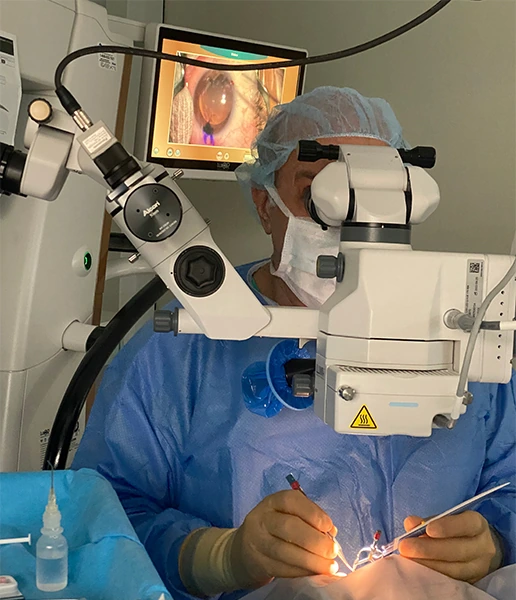
That matters practically when you are weighing timing. If you have a developing cataract and pressure that needs managing, one procedure may address both. Dr. Khosrof performs premium cataract surgery in an office-based setting, one of the few practices offering this, and he evaluates the drainage angle and the lens together rather than as unrelated problems.
Why Choose Dr. Samer Khosrof for Your Eye Care?
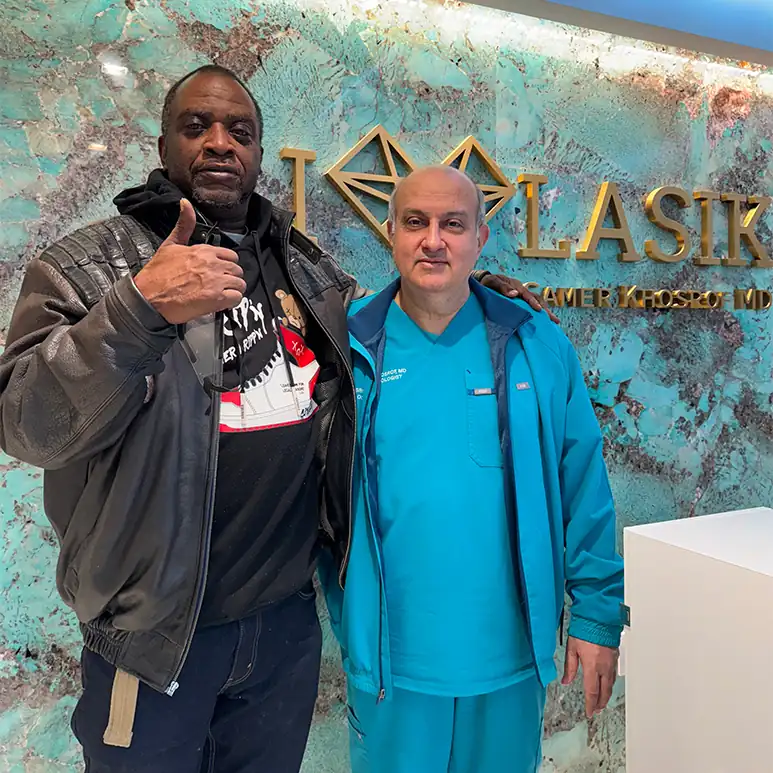
Dr. Samer Khosrof is fellowship-trained in vitreoretinal surgery, and that background shapes how he approaches glaucoma. Retinal surgeons spend their careers studying the optic nerve and the back of the eye in fine detail, which is precisely where glaucoma shows itself first. He is double-trained and is a pioneer in injectable treatment for macular degeneration. Over 25 years and more than 25,000 patients, he has learned to catch the optic-nerve changes that signal glaucoma early. He also performs humanitarian work with Physicians Without Borders.
What patients notice most is structural rather than clinical. Dr. Khosrof runs his practice as a one-man show by design. The person who evaluates your eyes at the consultation performs your surgery and sees you at every post-operative visit. For a condition diagnosed through subtle changes tracked across years, one consistent set of eyes following your case is a clinical advantage.
What Do Patients Say About Their Care?

He is very thorough and talks you throughout your procedure. His assistant is equally wonderful. Very caring staff and can't say enough about the doctor.- E.H.
I love this doc . I think he is the best eye doc.- M.E.
I’m incredibly grateful to Dr. Samer Khosrof for his expertise in preserving my vision. His professionalism and genuine concern for my well-being were evident from the initial consultation to the follow-up appointments. Dr. Khosrof’s dedication, along with the support of his exceptional team. I highly recommend Dr. Khosrof and his outstanding team for anyone seeking exceptional eye care.- L.E.

Schedule a Consultation
FAQs About Glaucoma
No. Optic nerve fibers lost to glaucoma do not regenerate, and no current treatment restores that vision. Treatment lowers eye pressure to protect the nerve tissue you still have, which is why the vision you keep depends so heavily on how early the disease is found.
Every one to two years, using a dilated eye exam that includes visual field testing. That interval applies if you are over 60, are Black and over 40, or have a family history of glaucoma.
Yes. A first-degree relative with glaucoma is among the stronger risk factors in the research, so adult children and siblings of a diagnosed patient should get their own baseline exam rather than wait for symptoms.
Usually. Dilation gives a clear view of the optic nerve and retina, and it leaves vision blurry and light-sensitive for several hours. Plan on someone else driving.
Yes. Glaucoma is a medical eye condition, so evaluation and ongoing management are generally billed through medical insurance. Elective vision correction is a separate, self-pay category, and consultations for those procedures carry an upfront fee credited toward the cost of surgery if you are confirmed a candidate.

Ready to Schedule a Glaucoma Evaluation?
Book an evaluation with Dr. Khosrof if any of these apply:
- Your pressure has been called elevated.
- Glaucoma runs in your family.
- You are nearsighted and have never had a baseline exam.
He sees patients from across NYC, Manhattan, Brooklyn, and the wider New York area, and he handles the full arc of care personally. Schedule a consultation to have your eye pressure, corneal thickness, and optic nerve health assessed properly.